
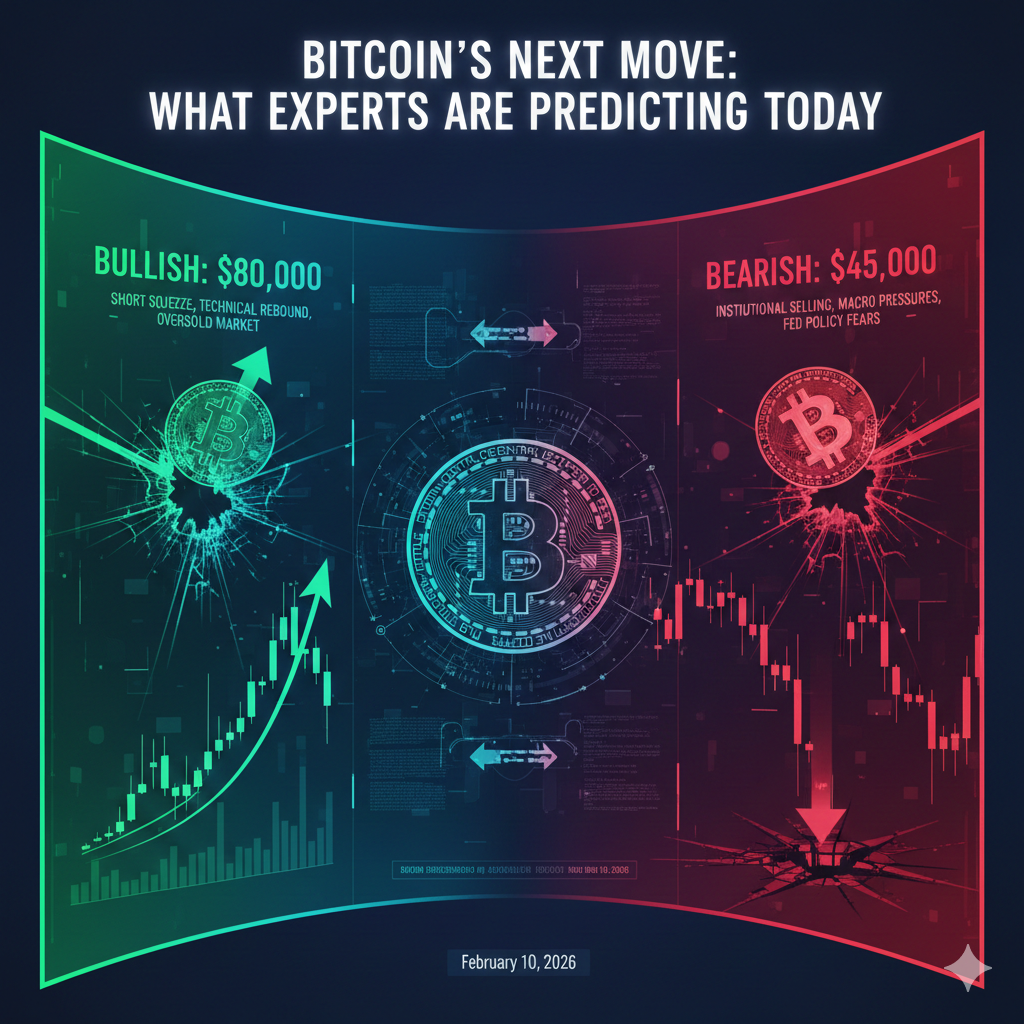
It is still Bitcoin as we look towards 2026 leading the way as the world’s biggest cryptocurrency, influencing the market and how traders, investors and institutions view digital assets.
Following a year of extreme volatility in 2025, BTC is still the standard bearer for crypto performance and overall market dynamics and investor sentiment. Institutional demand, regulation news and global macro factors are the three strongest narratives on Bitcoin right now.
BTC Price & Market Overview
In early February 2026, the price of Bitcoin is sitting at about $69,000 – $70,000 USD with massive volatility and heavy price fluctuation. Recent trading has seen BTC test and then regain the $70K price point on changing sentiment. Volume is down substantially, a sign of still-skeptical investor interest and slowing trading.
Market sentiment remains mixed:
-
On the one hand, some analysts are seeing value investors entering the market as prices fall, but others warn of more bearish pressures in the short term.
-
Analysts are monitoring a tug of war between pressure to correct and potential for recovery down the road.
Why 2026 Matters for Bitcoin
Bitcoin 2026 and the next halving in 2026 has become a big year for Bitcoin because:
-
Institutional coverage is growing — more financial entities are entering BTC markets or offering crypto services.
-
Market cycles and adoption patterns can adjust the tenor of long‑term growth after those tumultuous years of 2024–2025.
-
Oversight in primary markets (US, EU) is gradually improving which may influence long‑term investor confidence.
This year could determine whether Bitcoin does indeed go more mainstream and flatten out, or falls back into the rollercoaster‑like personality that’s come from its currency-like tendencies.
Key Events Impacting BTC
There are a number of key factors that will shape Bitcoin’s course over 2026:
-
Market Corrections & Volatility — BTC has experienced major corrections and recoveries, while the larger crypto markets have been responding to leverage unwinds and forced liquidations.
-
Institutional Flows — New capital inflow to Bitcoin ETFs and institutional long positions could keep price stable or rise in the short and medium term.
-
Global Economic Conditions — Macro headwinds, including inflation, interest rates and a broader risk‑asset sentiment factor into Bitcoin’s allure.
-
Regulatory Changes — The manner in which BTC is available to institutional investors may change due to continued policy development, i.e., CLARITY act etc.
How This Article Helps Investors
This article gives investors:
Instant market context — today’s price, sentiment and trend based on recent news.
What’s at stake in 2026 — implications for BTC with major economic and regulatory factors.
Powerful event analysis — so you’ll know how certain events could shape the price and trade accordingly.
Whether you’re a long‑term holder, a crypto trader, or just getting started, this article gives you insight into Bitcoin’s current state and how to plan more intelligent strategies five years from now.
Bitcoin Bullish Outlook for 2026
Analysts and market models remain bullish as Bitcoin fails to take advantage of a recent surge in trading volume. Many predictions focus on much higher prices compared with today, and not only from the $50‑60K area, but some believe these estimates could have an extra zero attached by the end of 2026. The long-term technical and institutional investment thesis points to further upside if BTC breaks critical resistance levels and ETF inflows continue.
Common Bullish Target Ranges
-
Base case: $110,000–$175,000 for 2026 based on institutional models.
-
Bullish predictions: $200,000+ possibilities if momentum and adoption pick up.
-
Extreme bullish scenarios: Models based on Bitcoin’s scarcity and on-cycle motion suggest $200,000–$300,000 in highly favorable conditions.
The bullish outlook relies on Bitcoin staying above critical support levels and continuing to attract serious investment from Wall Street through institutional investors and ETFs.
Expert Predictions for High Targets
Many prominent analysts and financial institutions have released lofty price targets for Bitcoin in 2026:
-
Fundstrat (Tom Lee): Long-term BTC bull sees $200,000–$250,000 by late 2026 based on institutional investment and ETF penetration.
-
Standard Chartered: Updated outlook to around $150,000 at the end of 2026, assuming sustained demand despite market corrections.
-
JPMorgan: Implied fair value around $170,000, based on asset allocation models comparing Bitcoin to gold.
-
CoinShares & Maple Finance: BTC expectations between $120,000–$175,000 in 2026.
Although targets differ by methodology, most forecasts point toward higher prices.
Technical Analysis Supporting Bull Case
-
Oversold recovery signs: Bitcoin indicators show potential for medium-term rebound.
-
Resistance levels: Immediate and medium-term resistance at $96,000–$100,000; breaking these could extend bullish momentum.
-
Technical models: Elliott Wave and other models suggest breaking $102K could push BTC toward $200,000+.
-
Risk & predictive gauges: Technical support zones and momentum indicators act as guides for potential upward moves.
Institutional Adoption & ETFs
Institutional flows and ETF growth remain top bullish catalysts for Bitcoin in 2026:
-
Spot Bitcoin ETFs attract significant inflows from wealth managers and institutional investors, creating sustained demand beyond new mining supply.
-
Market surveys indicate growing institutional involvement, with some aiming to hold up to 20% of Bitcoin’s circulating supply.
-
Regulatory clarity and ETF expansion make institutional exposure easier, boosting long-term confidence and price forecasts.
-
ETFs provide legitimacy for Bitcoin in large portfolios, helping drive prices higher.
Historical Patterns Indicating Growth
-
Post-halving trends: Upward price runs after Bitcoin halvings and adoption inflection points, though moves get smaller as markets mature.
-
Models like S2F: Predict higher price floors due to limited supply and growing demand.
-
Accumulation phases: Historically occur before major upward pushes, often driven by whales and institutional buy-in.
These historical trends support the idea that Bitcoin can maintain an upward trajectory in the long term, even with short-term pullbacks.
Bearish & Neutral Bitcoin Forecast
Although some analysts and models are bullish, the cryptocurrency community at large is now considering a potentially bearish or stagnant future for Bitcoin in 2026. Some technical configurations and macroeconomic forces are pointing to sideways or deeper corrections before a sustained uptrend — especially if key support levels fail and broader markets start trending lower again.
Lower Targets & Market Corrections
Bearish risk scenarios for Bitcoin in 2026 include:
-
BTC could face considerable resistance around current levels, with possible retests of previous ranges such as ~$84K, $70K, and mid/high-$58K if sellers persist.
-
Unless BTC breaks back above these levels, prolonged retracement similar to earlier corrections could occur.
-
Extreme contrarian views suggest that if general market conditions worsen dramatically, Bitcoin could test deeper lows such as $40K–$50K.
These low targets are bearish and corrective, showing how price might move if downward momentum dominates.
Key Risks Affecting BTC Price
Several risk factors could push Bitcoin lower or maintain neutral price action:
-
Market structure & technical setups: Breach of major support could trigger prolonged selloffs.
-
Regulatory uncertainty: Delays or poor decisions in crypto policy may slow adoption and spook investors.
-
Macroeconomic shocks: Large equity corrections or credit events can drag BTC lower along with other risk assets.
-
Technological threats: Speculative risks like quantum computing breaking encryption could impact long-term confidence.
Each of these risks could keep BTC in sideways or bearish ranges for extended periods.
Historical Downtrends & Consolidation Zones
Bitcoin’s past behavior shows patterns that could repeat:
-
BTC often experiences sharp corrections after peaks, sometimes falling 50% or more before bottoming.
-
Consolidation zones such as ~$84K and $70K previously acted as support or accumulation levels and may do so again.
-
During prolonged corrections or sideways markets, these historical support levels are important decision zones for traders and investors.
Keeping historical downtrends in mind helps maintain realistic expectations — markets rarely move straight up and often consolidate previous gains.
Expert Warnings & Caution Signals
Experts have issued cautionary advice for Bitcoin in 2026:
-
Elliott Wave analysts: Suggest a bear phase could extend into late 2026 if BTC has topped its cycle.
-
Technical indicators: Signals like the “death cross” or fragile momentum point to elevated downside risk until markets recover.
-
Strategist advice: Volatility and liquidity risks could cause deeper corrections or extended consolidations if markets turn bearish.
These warnings are not predictions that Bitcoin must fall — they highlight conditions where caution is advised, especially for short-term traders or leveraged positions.
Major Factors That Will Influence Bitcoin in 2026
Following are the real factors shaping Bitcoin’s price movement and investors’ behavior in 2026 — from macro pressures to supply dynamics and sentiment drivers.
Macro Factors – Fed, Dollar, and Liquidity
Monetary policy and the economic environment will be highly influential in shaping how Bitcoin performs:
-
Monetary Policy Impact: Bitcoin is increasingly correlated with conventional markets. Changes in U.S. Federal Reserve policy (interest rate cuts or hikes) directly impact risk-asset flows. Easing increases liquidity (positive for BTC), while tightening reduces potential funds flowing into crypto.
-
Dollar Strength and Liquidity: A weaker U.S. dollar tends to boost Bitcoin prices as global investors move money into risk assets. Conversely, a stronger dollar can decrease demand for BTC.
-
Global Risk Appetite: High global liquidity and strong risk appetite (equity markets rising) typically boost Bitcoin along with other risk assets.
In short, BTC is now more of a macro asset, with Fed policy, inflation expectations, liquidity, and FX as key price drivers heading into 2026.
Regulatory Changes & Global Laws
Regulation continues to drive Bitcoin adoption and price:
-
Regulatory Clarity in the U.S. (CLARITY Act & SEC/CFTC): Defining Bitcoin as a commodity and clarifying exchange treatment allows larger asset managers to allocate capital to BTC.
-
Global Frameworks (Europe’s MiCA, Asia Pacific Rules): Clear crypto laws encourage investment and institutional participation in BTC markets.
-
Risks of Tight Restrictions or Bans: Major economies imposing strict rules or bans will dampen demand and limit volatility in those regions.
2026 regulations are crucial because they reduce uncertainty, encourage institutional involvement, and unlock fund flows that were previously constrained.
Halving Effects & Supply Dynamics
Bitcoin’s supply dynamics remain an important factor, even as their market impact evolves:
-
Halving Mechanism: The 2024 halving reduced new Bitcoin supply, enforcing scarcity — a key feature of Bitcoin’s design.
-
Reducing Halving Anticipation: The 2026 halving may have less impact on price than previous cycles, as macro factors and institutional demand now play a larger role.
-
Scarcity & Liquidity: Much Bitcoin is now held long-term (“illiquid supply”). ETFs and other institutional instruments further reduce available coins on exchanges, which could support price if demand rises.
Overall, while halving slows supply growth, institutional demand and liquidity are becoming the main price determinants.
Market Sentiment & Investor Behavior
The psychology of traders and long-term investors is a major driver of Bitcoin’s price:
Fear & Greed Dynamics
-
Positive news: Institutional inflows or regulatory clarity often trigger buying.
-
Negative news: Macro stress or interest rate uncertainty can generate fear, leading to sell-offs.
Institutional vs Retail Flows
-
In 2026, BTC market structure is largely dominated by institutional investments (ETFs, asset managers).
-
This dominance reduces retail-driven volatility but can introduce systemic risks to traditional financial markets.
Demand Narrative
-
Bitcoin is increasingly viewed as digital gold, an inflation hedge, or a macro asset for portfolio diversification.
-
Investor sentiment and trading flows are strongly influenced by these narratives, often fueling rapid rallies or sell-offs.
Summary: Integrated Drivers in 2026
In 2026, Bitcoin’s movement is not dictated by a single factor but by the interplay of:
-
Macro forces (Fed policy, global liquidity)
-
Supply mechanics (halving, scarcity, ETFs)
-
Regulatory postures (clarity, restrictions)
-
Investor psychology (fear, greed, sentiment)
These combined drivers will largely determine whether Bitcoin trends upward, consolidates sideways, or experiences corrective movements throughout the year.
Expert Opinions & Predictions
Market expectations for Bitcoin come from leading analysis houses, banks, research firms, and boutique analysts. Experts use:
-
Historical data
-
Contemporary events
-
Advanced modeling techniques (AI, econometric models)
Predictions from Leading Analysts & Companies
-
Banks & Investment Firms: JP Morgan, Goldman Sachs, Citi provide projections on market rise or interest rate impact.
-
Boutique Analysts: Smaller firms or individual experts provide alternate forecasts.
-
Statistical Models: AI and econometric models offer numerical predictions with specific logic.
Why Experts Differ in Predictions
-
Divergent Assumptions: Differences in inflation, growth, or geopolitical risk assumptions.
-
Methodology: Technical analysis vs. fundamental analysis vs. AI models.
-
Time Frame: Some experts focus on short-term trends, others on long-term outlooks.
-
Risk Appetite & Bias: Analysts’ personal risk tolerance can influence forecasts.
Short-term vs Long-term Views
Short-term Predictions
-
Typically months to 1 year.
-
Heavily influenced by news events, sentiment, and volatility.
-
Useful for traders or investors looking to capitalize on quick market movements.
Long-term Predictions
-
Extend across multiple years.
-
Based on structural factors such as demographics, technology adoption, monetary policy, and regulatory trends.
-
Helpful for long-term holders and strategic planning.
Consensus Summary
-
Combines all expert opinions into a general overview.
-
Usually expressed as a range or average estimate.
-
Invaluable for investors or decision-makers to understand the “consensus market expectation” versus extreme views.
-
Charts or tables can be included to clarify and visualize predictions.
Key BTC Price Levels to Watch (2026)
Major Support & Resistance Zones
Important levels where buyers or sellers enter the market. Holding or breaking these zones can determine the next big move.
Key Support Zones
-
$83,000–$88,000 — strong near-term support; BTC has bounced off multiple times in recent weeks.
-
$84,000–$86,000 — institutional order range and support zone.
-
$80,000–$76,000 — further support if momentum fades significantly.
-
$55,000–$70,000 — historical lower supports during severe corrections.
Key Resistance Zones
-
$89,500–$90,800 — current psychological and technical resistance range.
-
$92,000–$95,000 — higher resistance before six-figure moves.
-
$96,000–$105,000+ — medium-term resistance consolidation clusters watched by traders for breakouts.
These areas frequently serve as demand (support) or supply (resistance) since many traders and funds have resting orders here.
Breakout & Breakdown Thresholds
Watch these levels closely — they indicate trend changes when BTC decisively moves above or below them.
Bullish Breakout Levels
-
Over $90,500–$92,000: Break above may drive BTC to $96K–$102K+ handles.
-
Long-term break above $95,000–$100,000: Signals stronger bullish continuation.
Bearish Breakdown Levels
-
Under ~$83,000: Could accelerate downside, retesting $80K or lower.
-
$76,000–$70,000: Major breakdown here increases probability of extended corrections.
Breaks of these thresholds often spike volume, amplifying price moves.
Psychological Price Levels
Whole-number levels that large traders monitor to place stop orders — acting like invisible magnets for price:
-
$80,000 — strong support above this level.
-
$90,000 — key psychological barrier.
-
$100,000 — investors watch this as a major threshold.
-
$120,000+ — significant long-term breakout level.
Price reactions are usually more volatile near these numbers due to trader actions.
Actionable Levels for Traders
✔️ Possible Buy Zones
-
$83,000–$86,000 — entry on pullbacks in price.
-
Break retest of $90K — bullish entry after clear breakout.
-
$80,000 — deeper support for dip buyers.
✔️ Possible Sell / Take-Profit Zones
-
$92,000–$95,000 — intermediate resistance for partial exits.
-
$96,000–$105,000 — higher swing traders’ targets.
-
Over $100,000 — psychological gain zone if momentum stays strong.
Tip: Always confirm entries/exits using volume breakouts, candlestick closes, RSI/MACD, and other technical indicators to validate actionable levels.
Quick Summary Table
| Level Type | Price Zone | Significance |
|---|---|---|
| Strong Support | $83K–$88K | Buyers stepping in |
| Deep Support | $80K–$76K | Lower demand pool |
| Key Resistance | $90K–$95K | Bulls need breakout |
| Breakout Trigger | >$95K | Bullish continuation |
| Psychological Level | $100K | Major trader focus |
BTC vs Gold & Stocks
Bitcoin behaves differently compared to traditional assets such as gold and stocks, offering both opportunities and risks.
Bitcoin vs Gold
-
Bitcoin is much more volatile than gold — it can rise faster but also crash harder.
-
Long-term, Bitcoin has outpaced gold in returns, but gold retains safe-haven credibility during market stress.
-
Correlation with gold is minimal, so holding both can diversify portfolio risk.
Bitcoin vs Stocks
-
Bitcoin is more correlated to stocks, especially tech indices, than gold.
-
It tends to rise in risk-on environments and fall when markets sell off.
-
In short: Bitcoin is more volatile than gold but can outpace stocks during expansion cycles.
Hedge or Risk Asset?
Bitcoin’s role in a portfolio is debated between risk asset and hedge/diversifier.
Risk Asset Traits
-
Bitcoin’s price can correlate with broader market sentiment, especially tech stocks.
-
During market sell-offs, Bitcoin may decline along with equities, showing limited safe-haven behavior.
Hedge / Diversifier Traits
-
Bitcoin has a low long-term correlation with stocks and bonds, making it useful for diversification.
-
Some institutions view Bitcoin as a macro hedge, particularly against inflation or currency devaluation.
Summary
-
Bitcoin acts mostly as a risk asset during calm or booming markets.
-
During stress events, it can function as a partial hedge, though less consistently than gold.
Correlation with Global Markets
-
Bitcoin’s correlation with stocks and tech indices has increased in recent years during risk-on periods.
-
Correlation with gold and bonds remains low, so Bitcoin trades relatively independently.
-
Occasionally, Bitcoin trends inversely to the U.S. dollar, benefiting when the dollar weakens.
Takeaway
Bitcoin doesn’t move perfectly in sync with stocks, gold, or bonds, making it useful for diversification. Its correlation patterns, however, shift with market cycles.
Conclusion: Balanced Prediction Summary on Bitcoin’s Future
Bitcoin’s price outlook for 2026 remains wide, uncertain, and multi-directional. Experts point to bullish, neutral, and bearish scenarios, reflecting diverse market forces and investor sentiment.
The Bulls Beckon: Opportunities for Investors
Price Range
-
Predictions vary widely: $75K–$100K, $150K–$250K, and even higher depending on adoption and institutional inflows.
Institutional Demand
-
Increased Bitcoin ETFs and large institutional capital inflows are primary upside drivers.
-
Could provide structural support for higher prices.
Macro & Legal Regulations
-
Central bank policies, interest rate changes, liquidity, and crypto regulations will influence BTC’s trajectory in 2026.
Volatility
-
Despite growing adoption, short-term price fluctuations are expected in both directions.
Opportunities
-
ETF & Allocation Growth: Rising institutional demand may push BTC to new all-time highs.
-
Decoupling from Stocks: Bitcoin’s correlation with stocks may weaken, increasing its diversification benefits.
-
Structural Adoption: Deeper adoption by industries and governments could strengthen demand.
⚠️ Risks
-
Regulation: New rules, bans, or taxation could curb the market and limit Bitcoin’s investment role.
-
Correction & Fluctuation: Bitcoin remains volatile, with temporary injections or sell-offs impacting price.
-
Competition: Emerging cryptocurrencies may divert investment away from Bitcoin.
Expert Opinion Summary
-
Bullish Experts: Focus on structural adoption, ETF growth, and capital inflows, predicting prices could break previous records in 2026.
-
Neutral Experts: Expect Bitcoin to trade within a range, influenced by market psychology and minor fluctuations.
-
Bearish Experts: Warn of political, regulatory, or macro headwinds that could drive corrections.
Brief Takeaway
-
2026 is shaping up as a decisive year for both Bitcoin’s price and its role as an investment asset.
-
Understanding the full spectrum of bullish, neutral, and bearish scenarios is essential for informed decision-making before taking action.
FAQ: Bitcoin 2026 Predictions
Will BTC break its all-time high?
-
Many experts believe yes, Bitcoin could set a new all-time high in 2026.
-
Firms like Grayscale and Bitwise predict Bitcoin may surpass its previous high (~$126,000) due to institutional demand, ETFs, and clearer regulations.
-
Targets vary widely: some estimate $150K–$250K+, depending on macro factors and capital flows.
✅ Takeaway: A 2026 all-time high is possible if major bullish drivers align.
Could Bitcoin tank under massive support?
-
Yes — crypto markets are highly volatile. BTC could fall to bearish scenarios if macro headwinds, risk-off sentiment, or regulatory setbacks occur.
-
Analysts point to price floors around $60,000–$70,000 if major supports are breached.
-
Bitcoin has a history of large corrections; another one is possible.
⚠️ Warning: Investing on pure upside potential without risk planning is reckless.
What catalysts could change forecasts?
Key factors that can impact Bitcoin’s trajectory in 2026:
Institutional Adoption & ETF Flows
-
More institutional capital = higher BTC demand.
Macro Policy Shifts
-
Fed cuts or liquidity injections can improve risk-asset sentiment, benefiting BTC.
Regulatory Clarity
-
Transparent crypto regulations in the US and Europe can attract long-term investors.
Market Sentiment
-
Extreme fear or greed can reverse BTC price quickly (capitulation or bullish conviction).
These catalysts can turn bearish outlooks bullish — or vice versa — faster than most expect.
As a beginner, how should I go about BTC in 2026?
Tips for beginners in Bitcoin investing:
Start small: Invest only what you can afford to lose.
Dollar-Cost Averaging (DCA): Invest fixed amounts regularly instead of lump sums.
Set risk limits: Plan profit-taking and stop-loss points in advance.
Learn market cycles: BTC follows cyclical patterns influenced by macro factors.
Think long-term: Avoid short-term speculation; treat BTC as an asset, not just a trade.
Beginner mindset: Being a “hodler” isn’t enough — always DYOR (Do Your Own Research) before investing.